 5:54
5:54
Algebra 1
Intro
The Real Number System
Naturals, integers, rationals, irrationals — and which box a number lives in.
Algebra 1 is the course everything else is built on. Lines, systems, factoring and quadratics account for most of it, and the students who do well later are the ones who can factor and graph without thinking hard about it. Every topic here links to unlimited practice on the AlgeBridge platform.
46 topics · 9 units
The number system, the properties you are allowed to use, and exponent rules that everything later depends on.
5:54
Naturals, integers, rationals, irrationals — and which box a number lives in.
 24:45
24:45
Commutative, associative, distributive, identity, inverse — the rules that justify every step.
 9:43
9:43
Multiply means add, divide means subtract, power of a power means multiply.
 12:37
12:37
What a negative exponent actually means, and why it is not a negative answer.
 10:27
10:27
Writing very large and very small numbers without counting zeros.
 3:09
3:09
Pulling perfect squares out from under the root sign.
Solving for one unknown in every arrangement it can appear, including formulas with several letters.
 8:58
8:58
Simplify each side first, then isolate — in that order.
 6:45
6:45
Getting every x onto one side, and what it means when they all disappear.
 5:36
5:36
Clear every denominator in one move and never work with fractions again.
 4:55
4:55
Solving a formula for one letter when everything else stays symbolic.
 13:12
13:12
Why these usually have two answers, and when they have none.
Solution sets instead of single answers, written on number lines and in interval notation.
 30:44
30:44
Everything from equations carries over, except one rule.
 11:45
11:45
AND means overlap, OR means everything either one covers.
 13:12
13:12
Less than gives a sandwich, greater than gives two pieces.
The central object of the rest of mathematics. Inputs, outputs, and the notation that comes with them.
 10:54
10:54
The one rule that decides whether a relation is a function.
 11:49
11:49
 12:51
12:51
 7:31
7:31
Reading intercepts, increases, maximums and meaning off a picture.
Lines in every form, what each form is good for, and how to move between them.
 7:06
7:06
Computing steepness from two points without a graph.
 8:59
8:59
y = mx + b, the form you can graph without any work.
 3:58
3:58
The fastest way to write a line's equation from a point and a slope.
 3:23
3:23
Ax + By = C, and the two-point shortcut for graphing it.
 9:13
9:13
Same slope, or negative reciprocal slopes.
 8:03
8:03
A boundary line plus a shaded half-plane.
 3:18
3:18
Finding a trend in messy data, and the limits of trusting it.
Two equations, two unknowns, and three methods with different strengths.
 8:30
8:30
The intersection point, and what parallel or identical lines mean.
 4:38
4:38
Best when one variable is already alone, or easy to isolate.
 10:20
10:20
 12:44
12:44
Two unknowns, two facts, and a reliable setup routine.
 10:56
10:56
Multiplying expressions out, and the much harder skill of putting them back together.
 17:52
17:52
Combining like terms, with one sign trap when subtracting.
 6:25
6:25
Four products, and why FOIL is only a special case.
 4:06
4:06
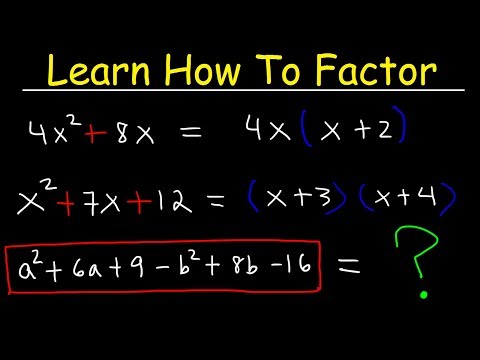
Three patterns that save time and are essential for factoring later.
 34:45
34:45
 11:22
11:22
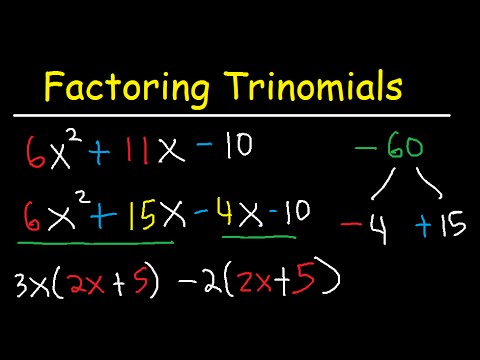
Finding two numbers that multiply and add correctly.
 11:03
11:03
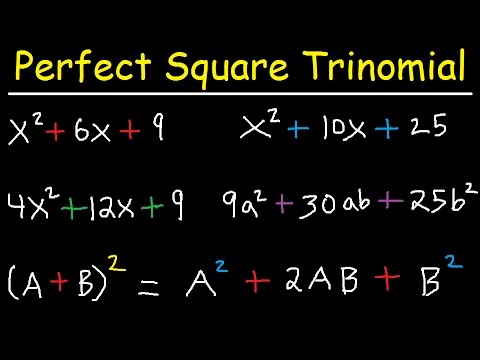
Difference of squares and perfect square trinomials, spotted instantly.
Parabolas, and four different methods for solving the equations behind them.
 7:58
7:58
Vertex, axis of symmetry, direction, and how wide it opens.
 7:16
7:16
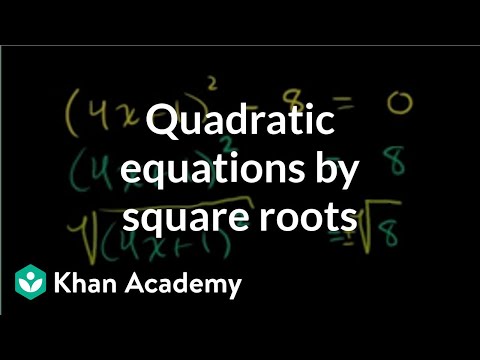
The zero product property, and why one side must be zero first.
 11:03
11:03
 14:05
14:05
Manufacturing a perfect square, and where the quadratic formula comes from.
 10:14
10:14
The method that always works, and what the discriminant predicts.
 5:58
5:58
Projectiles, areas and maximum profit — where parabolas describe reality.
Growth that multiplies instead of adds, and the patterns behind both kinds.
 5:31
5:31
When the variable moves into the exponent, everything changes.
 7:21
7:21
Percent change per period, written as a multiplier.
 6:16
6:16
Adding the same amount each time — a linear function on the integers.
 10:45
10:45
Multiplying by the same amount each time — an exponential on the integers.