 14:26
14:26
Geometry
Intro
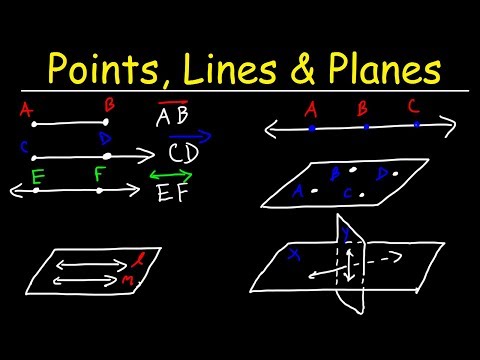
Points, Lines & Planes
The three things geometry refuses to define, and why that is deliberate.
Geometry is the course where you stop taking results on trust and start proving them. It is also the one that looks least like the algebra either side of it, which catches students out. The reasoning skills built here — stating what you know, justifying every step, spotting what a diagram does and does not tell you — are what the rest of mathematics assumes you have.
43 topics · 7 units
The undefined terms everything is built from, and the reason geometry is the course where you finally have to prove things.
14:26
The three things geometry refuses to define, and why that is deliberate.
 15:14
15:14
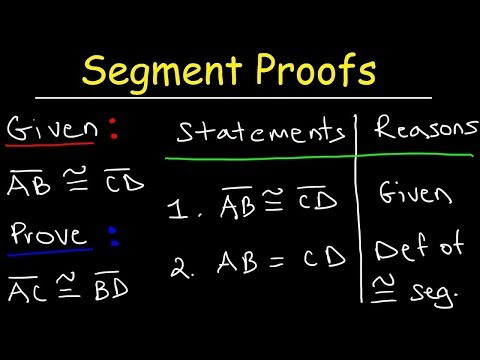
Adding lengths along a line, and finding the exact middle.
 14:24
14:24
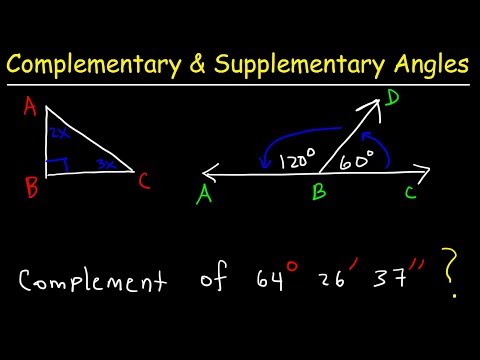
Vertical, linear, complementary and supplementary pairs, used as equations.
 7:07
7:07
Eight angles, two sizes, and the converses that prove lines parallel.
 11:54
11:54
If-then statements, their converse, inverse and contrapositive.
 11:40
11:40
Statements on the left, reasons on the right, and how to get unstuck.
The centre of the course. Five congruence criteria, what they unlock, and the special segments inside every triangle.
 12:40
12:40
 3:56
3:56
Same shape and size, defined by motion rather than by measurement.
 29:22
29:22
 15:24
15:24
The angle-based criteria, and the one reserved for right triangles.
 3:53
3:53
 9:03
9:03
Equal sides force equal angles, and the converse holds too.
 5:52
5:52
Which three lengths can actually form a triangle, and which angle is biggest.
 17:56
17:56
Four segments, four points of concurrency, and what each one does.
 3:07
3:07
Join two midpoints and you get a parallel segment, half as long.
Same shape at a different scale, and the right-triangle results that fall out of it.
 4:54
4:54
Equal angles, proportional sides, and what scaling does to perimeter and area.
29:22
Why two angles are enough to prove triangles similar.
 23:53
23:53
A line parallel to one side cuts the other two proportionally.
 24:50
24:50
Drop an altitude to the hypotenuse and three similar triangles appear.
 2:48
2:48
Using a² + b² = c² backwards to classify any triangle.
 11:11
11:11
45-45-90 and 30-60-90, and the shortcuts they give you.
 10:33
10:33
The family tree of four-sided figures, what each one guarantees, and how to prove which is which.
 9:10
9:10
Interior angles grow with the number of sides; exterior angles never do.
 20:51
20:51
 11:02
11:02
Three special parallelograms and the diagonal test for each.
 13:36
13:36
 11:08
11:08
Choosing the least work needed to classify a shape.
Angles, arcs, chords and tangents — a set of theorems that all reduce to one relationship.
 32:30
32:30
Radius, chord, secant, tangent, and the words the theorems depend on.
32:30
 14:16
32:30
14:16
32:30
Vertex inside gives half the sum; vertex outside gives half the difference.
32:30
Perpendicular bisectors through the centre, and the products that stay equal.
 15:57
15:57
 3:51
3:51
Measuring flat figures precisely, then moving into three dimensions.
 23:34
23:34
 13:55
13:55
 3:17
3:17
 5:29
5:29
Slicing a solid, and spinning a flat shape into one.
 5:22
5:22
Where geometry and algebra meet: proving theorems with formulas, and defining congruence by motion.
 9:39
9:39
The Pythagorean theorem and an average, doing most of coordinate geometry.
 9:06
9:06
Proving a theorem for every case by using variables instead of numbers.
 7:22
7:22
Translations, reflections, rotations, and the symmetry they reveal.
 4:59
4:59
The one transformation that changes size, and what it preserves.